
NanoGenesis
An idle game about growing a self-replicating swarm of nanobots until it can cage a star. Free to play, no download, and it keeps running while you're away. Also an experiment in game design — the systems are ours, and AI brings the vision to life.
What is NanoGenesis?
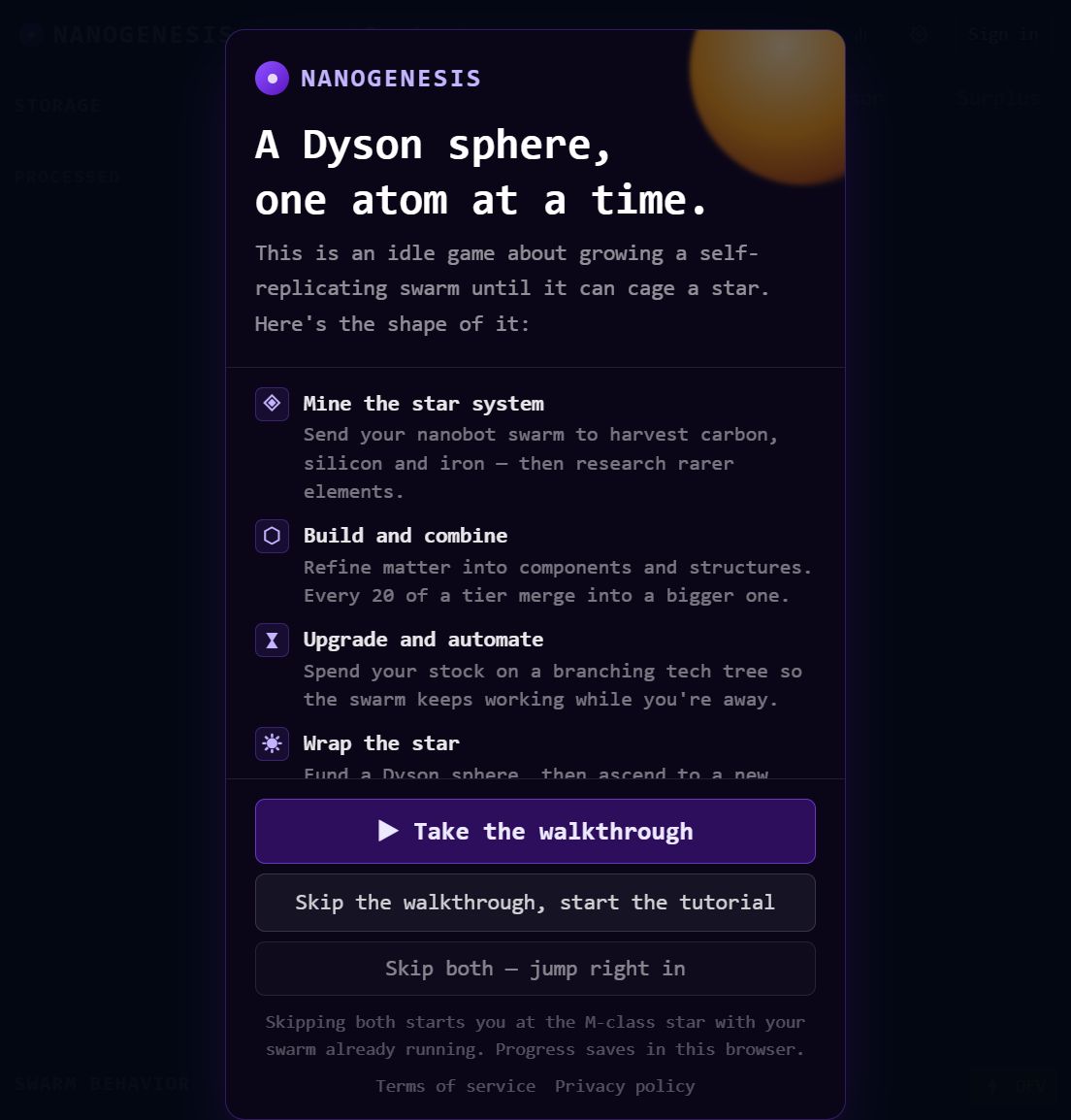
NanoGenesis is a free browser-based idle game in which you grow a self-replicating nanobot swarm until it can enclose a star in a Dyson sphere. It runs entirely in the browser, needs no account, and saves to local storage.
You start with a single nanobot swarm and a protostar, and you finish — many hours later — with a Dyson sphere wrapped around a star. In between sits an economy: raw matter harvested from orbit, refined up a five-tier production chain, assembled into megastructures, and spent on a branching research tree that makes the whole thing run itself.
It is a game about compounding. Early on you are clicking through single units of carbon; by the late game your swarm is pulling thousands of tonnes per second out of a star's photosphere while you are elsewhere. The interesting decisions are about what to build next, not about how fast you can tap.
The simulation is fully client-side. There is no server doing the maths, no account required to play, and every run is saved to your own browser's local storage. You can install it to your home screen as a Progressive Web App and it will still open.
NanoGenesis is also an experiment in game design. The mechanics, the economy and the progression are ours; we use AI to turn that design into working code and artwork. It is how a small studio ships a game this large without a team of twenty — and it is the reason the project exists. The question it is testing is whether an idea can be carried from sketch to playable without losing its shape along the way. See how we use AI for the process.
Screenshots
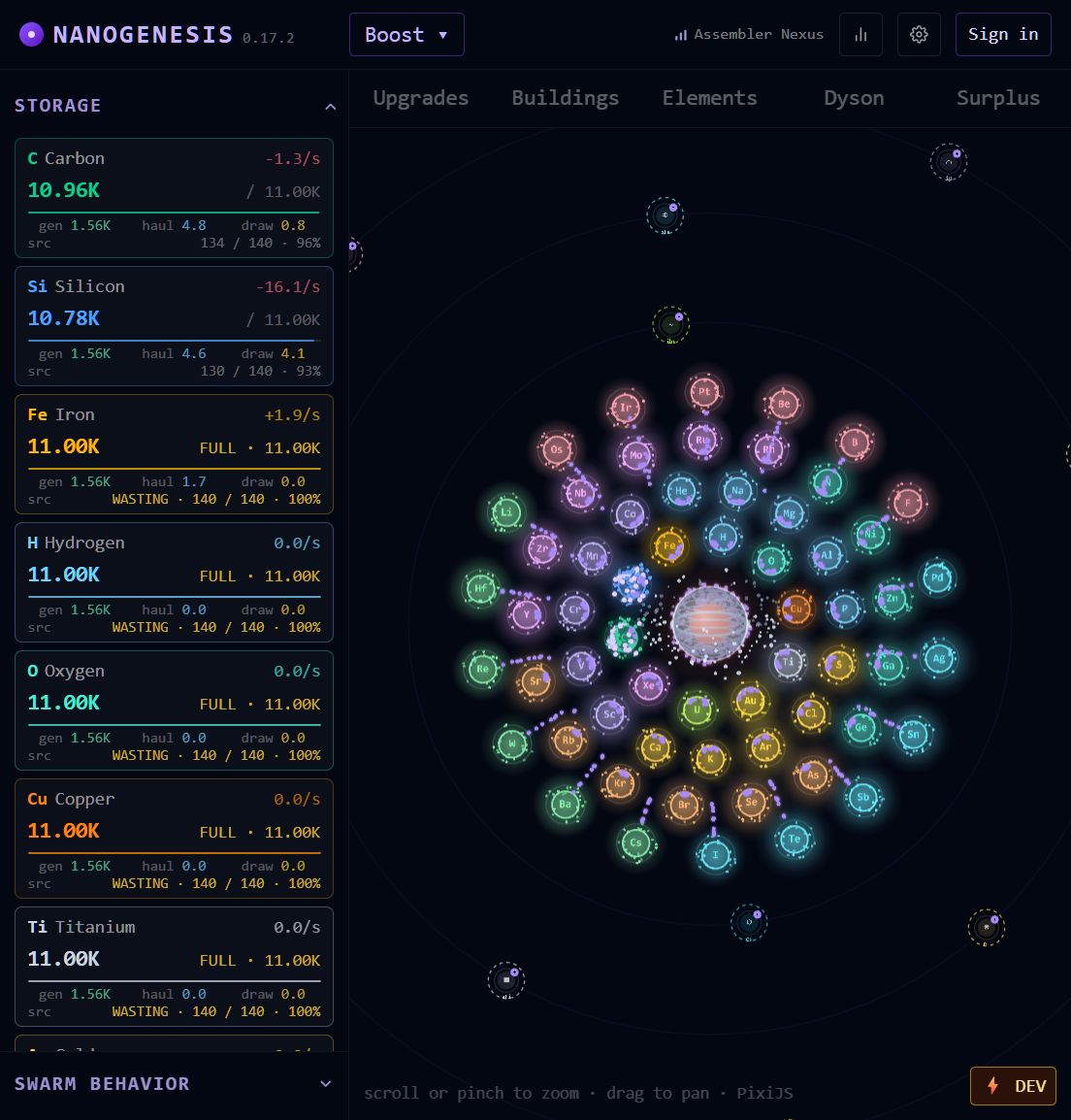
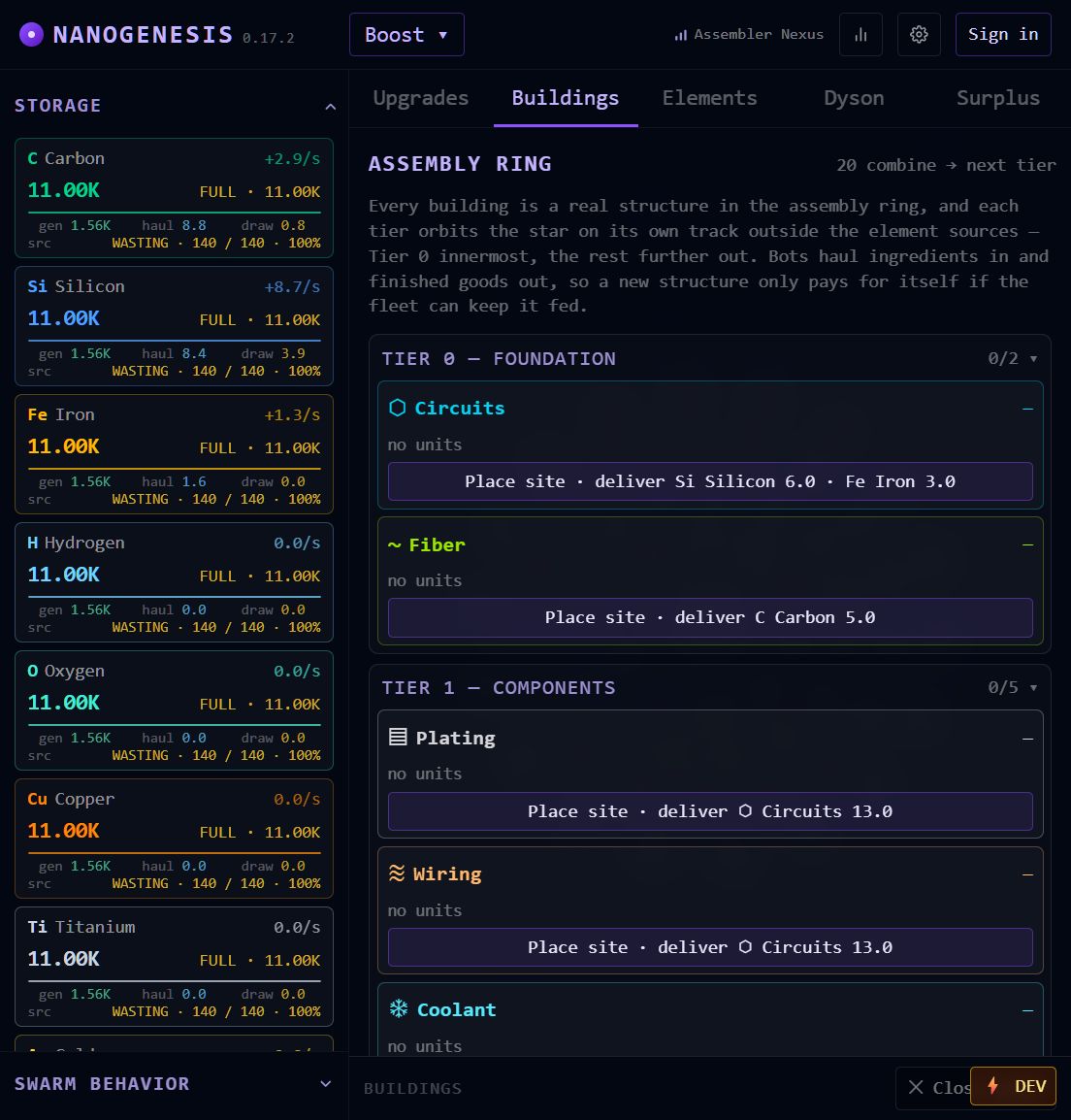
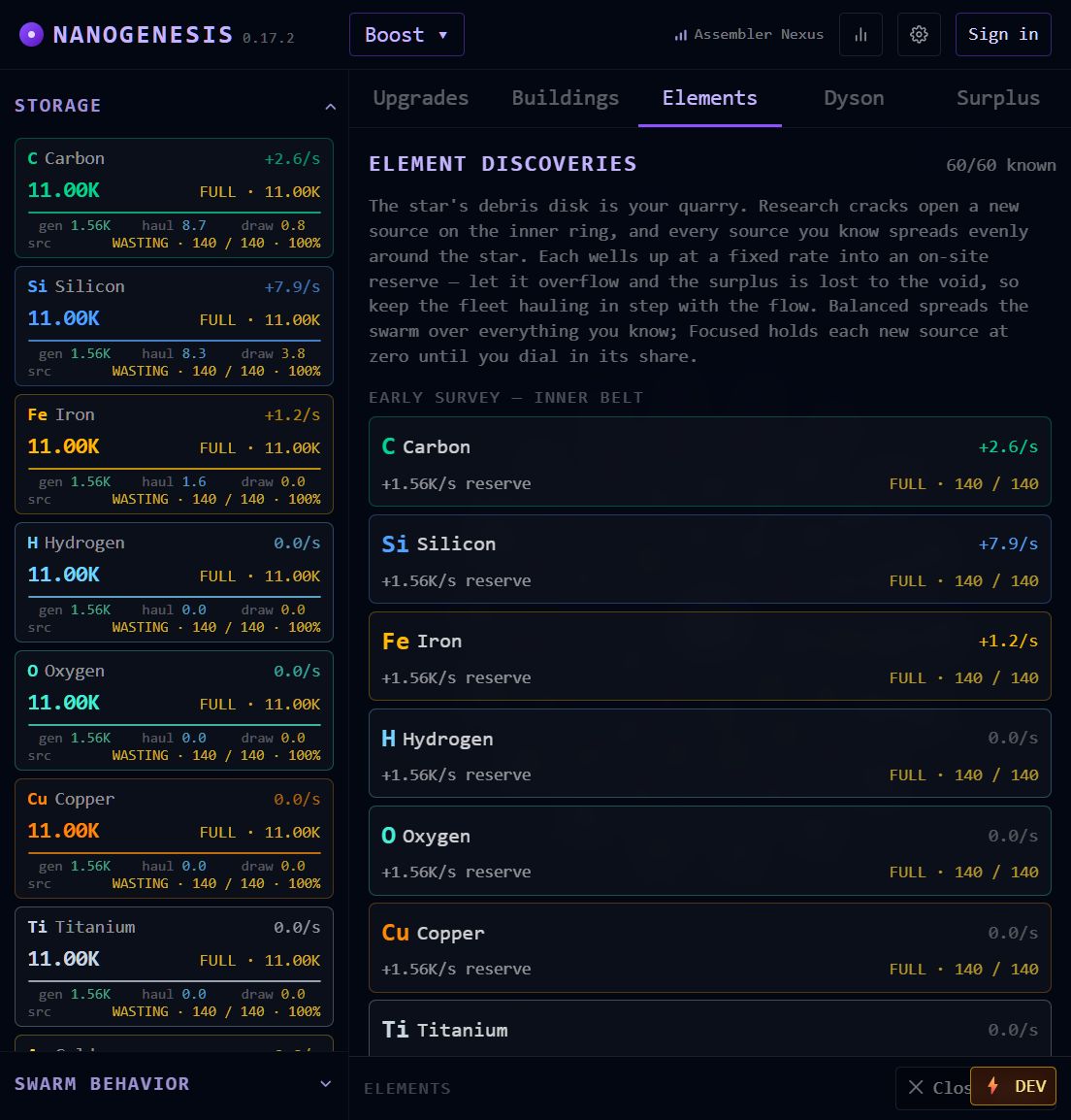
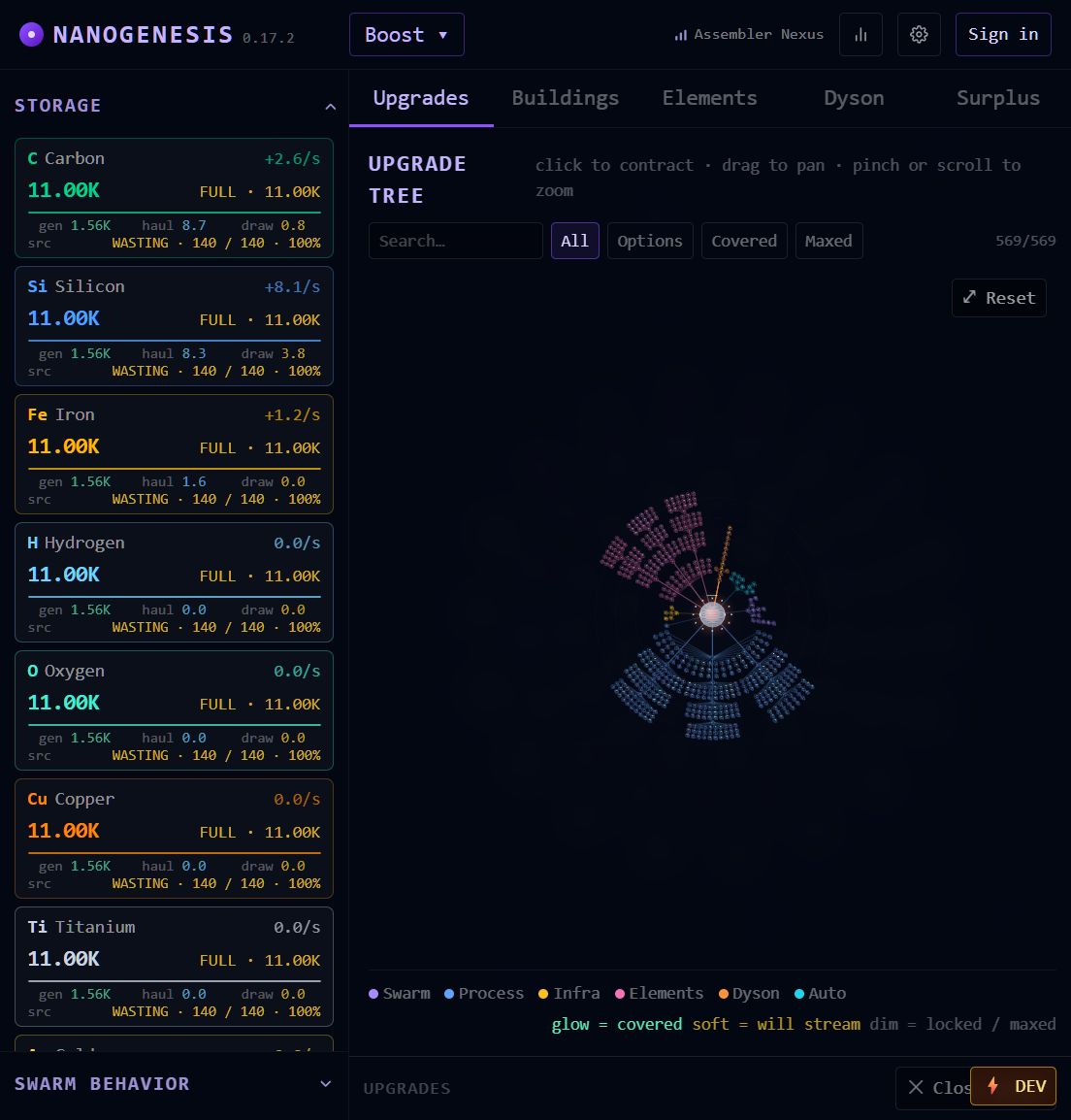
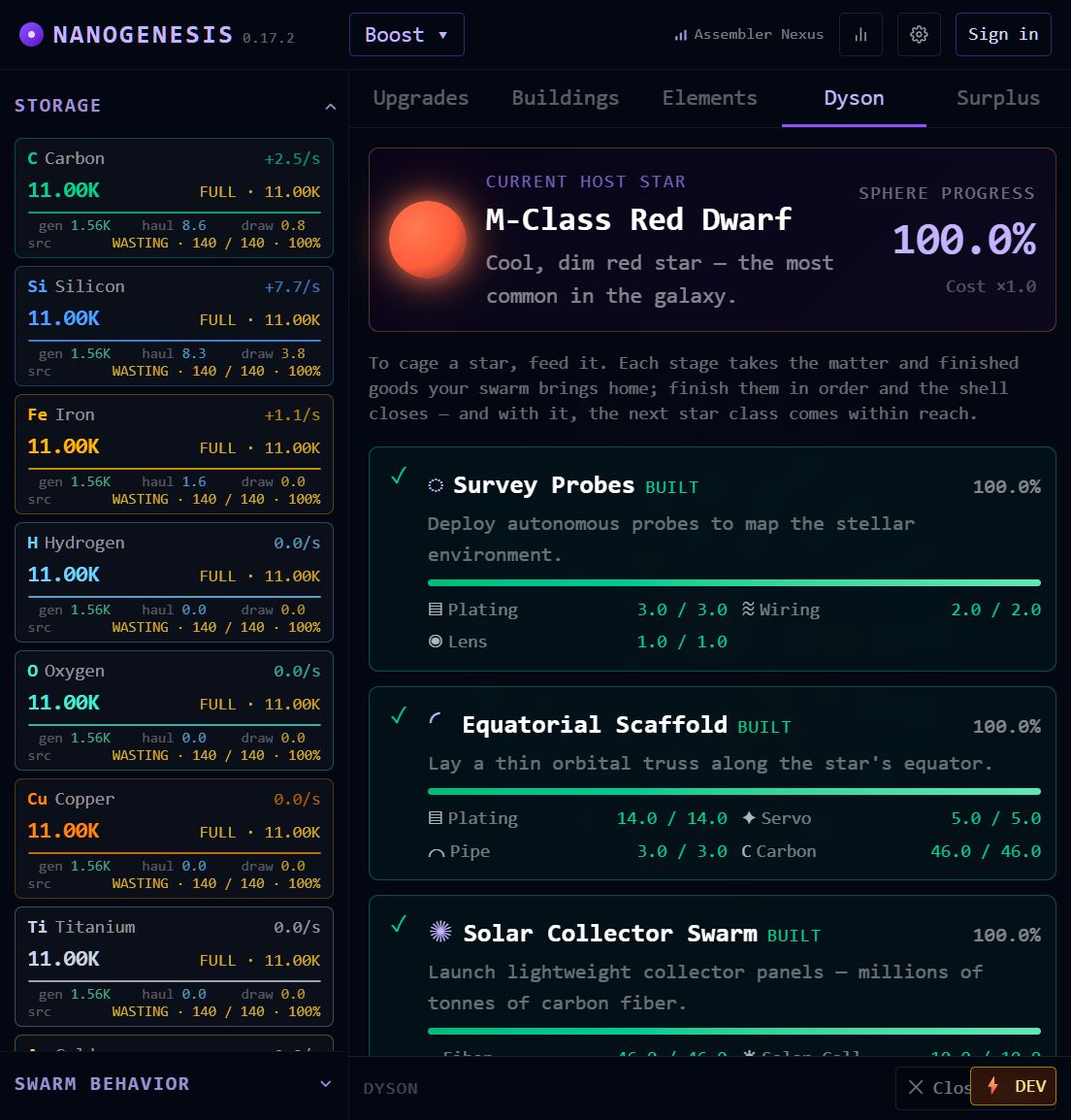
What it actually looks like.
Captured from build 0.17.2 with the full element catalogue discovered — the late-game view, not the tutorial.
How It Plays
Four things, in order, forever.
1. Harvest the star system
Send your swarm to the sources visible from your current star: carbon, silicon and iron at the start, then rarer elements as you ascend. Research is what unlocks a new source — and each survey costs matter you have already refined, so early resources never stop mattering.
2. Refine and combine
Matter moves up a five-tier production chain across twenty processed goods. Build the parts, and feed twenty identical units of one tier into a single unit of the next. The merge maths is the spine of the game: it is why a factory making tier three parts is worth more than five making tier two.
3. Automate everything
Six upgrade branches — Swarm, Processing, Infrastructure, Elements, Dyson and Automation — turn a manual loop into a machine. Logistics is simulated properly: bots travel, jobs are assigned, transfers are buffered. Automation is what eventually lets you close the tab.
4. Wrap the star, then ascend
Funding a Dyson sphere is a seven-stage build, and it does not end the game. Each completed sphere lets you ascend to the next stellar class, carrying permanent bonuses forward and revealing a new slice of the element catalogue.
Ten stars, sixty elements
The long game is a ladder of ten star classes, from an M-class red dwarf up to the exotic end of the catalogue. Each era reveals five or six new elements, for sixty in total, and the ordering follows real nucleosynthesis rather than a made-up tech tree: hydrogen and helium first, then the alpha-process elements forged in massive stars, then the iron peak from supernovae, and finally the s-process and r-process products that only exist because stars died and seeded the next generation.
That progression is the reason ascending feels like progress rather than a reset. Later stars are born from richer gas, so heavier elements are available to you — which is roughly how galactic chemical evolution actually works.
| Era | Elements added | Running total |
|---|---|---|
| 1 | H, C, O, Si, Fe, Cu, Ti, Au, U, Xe | 10 |
| 2 | He, Na, Mg, Al, P | 15 |
| 3 | S, Cl, Ar, K, Ca | 20 |
| 4 | Sc, V, Cr, Mn, Co | 25 |
| 5 | N, Ni, Zn, Ga, Ge | 30 |
| 6 | As, Se, Br, Kr, Rb, Sr | 36 |
| 7 | Y, Zr, Nb, Mo, Ru, Rh | 42 |
| 8 | Pd, Ag, Sn, Sb, Te, I | 48 |
| 9 | Cs, Ba, W, Re, Hf, Li | 54 |
| 10 | Os, Ir, Pt, Be, B, F | 60 |
Playing away from the tab
Idle games live or die on what happens when you leave. NanoGenesis simulates your time away rather than simply multiplying your last rate: when you return, it replays a reduced version of the production chain, generation, logistics and Dyson construction to work out what your swarm actually managed. The report you get on return lists what was produced, what was spent and what overflowed.
Because the game is a Progressive Web App it can be installed from your browser — on Android and desktop Chrome, and on iOS through Safari's "Add to Home Screen" — and it will launch and play without a network connection. Your save is stored in your browser, so it survives closing the tab.
Free to play, and still in beta
NanoGenesis is free. You do not need an account, an email address or a payment method to play, and the whole simulation is available without one.
An optional account exists for one reason: cloud saves. If you create one, your progress follows you between devices. There are no ads in the game. Optional permanent boost packs exist for players who want to support development. Our privacy policy covers what is stored and where.
The game is in beta: balance, pacing and late-game content are still moving, so expect things to change between releases.
Frequently asked questions
Do I need an account to play?
No. The game opens and saves locally without one. An account is only needed for cloud saves across devices.
Does it work offline?
Yes. Once the page has loaded — or once you have installed it as an app — it plays without a connection, and time spent away is simulated when you return.
What devices does it run on?
Any reasonably modern browser on desktop, Android or iOS. It is designed to work on a phone screen as well as a desktop one, and it installs as a PWA on all three.
How long is a run?
The first star takes a few hours. The full ladder of ten stars is a long, slow build measured in weeks of occasional check-ins — which is the point of an idle game.
Where is my save stored?
In your browser's local storage, under a key scoped to whichever identity you are playing as. Clearing site data will delete it. That is the reason cloud saves exist.
Is it really free?
Yes. There are no ads, nothing is gated behind a purchase, and the game never asks for payment to continue. Optional boost packs exist for players who want to support development.
Something is broken. Who do I tell?
Email tech@mochacidal.com with your browser and roughly where you were in the game, or use the contact form.
Start with one nanobot.
NanoGenesis runs in the browser, saves in the browser, and needs nothing installed to begin. You can always install it later.
Play NanoGenesis